What Actually Happens on a Wellbeing Retreat? A Practical Guide for First-Timers
What Actually Happens on a Wellbeing Retreat? A Practical Guide for First-Timers
If you’ve been thinking about going on a retreat but aren’t quite sure what it involves, you’re in good company. For many people, the idea of retreat time feels appealing in the abstract — a pause, some nature, space to breathe — but slightly opaque in practice. What do you actually do? Is it structured or freeform? Will you feel awkward? Will it feel worth it?
This guide is for anyone who’s asked those questions. It’s a straightforward account of what a wellbeing retreat typically involves, what you can expect from the experience, and how to know whether the time is right.
The Most Common Misconception About Retreats
The most persistent misconception is that retreats are for a particular kind of person — spiritually experienced, already calm, comfortable with silence, somewhere on the further end of the yoga-and-meditation spectrum. That’s not true, and it keeps a lot of people from trying something that might genuinely serve them.
Retreats are for people who need a break from the pace they’re living at. That’s a very large category. It includes people in the middle of difficult transitions, people who are tired in ways a holiday hasn’t fixed, people who are curious about a different rhythm, and people who simply want to be in nature for a few days without the usual noise.
No experience is required. No practice is assumed. Turning up is the only real prerequisite.
A Typical Day: What the Rhythm Looks Like
Retreat programs vary considerably, but there are rhythms that appear consistently across most wellbeing retreats in the UK.
Mornings tend to be gentle. Breakfast is usually unhurried, often shared. Some retreats offer an optional morning practice — a walk, a brief meditation, a movement session — but these are rarely compulsory and rarely early. The intention is to let the day begin at its own pace rather than demanding you hit the ground at speed.
The middle of the day might include a facilitated session — a workshop, a group conversation, a creative practice — depending on the retreat’s focus. Or it might simply be open time: walking, reading, resting, being outside. Many retreat programs include a deliberate amount of unscheduled time because the value of that space is part of the point.
Evenings are usually communal — a shared meal, an optional gathering, or simply time with whoever else is there. They tend to end early. There is rarely anything competing for your attention after nine.
Do You Have to Participate in Everything?
At most wellbeing retreats, participation is invited rather than required. You won’t be coaxed out of a walk you wanted to take or made to feel conspicuous for skipping a session. The best retreat environments are those where the program is offered as a resource rather than a schedule.
That said, it’s worth knowing your own patterns. If you’re someone who uses solitude to avoid discomfort, a small nudge towards participation can be valuable. If you’re someone who finds group settings draining, choosing a retreat with a lighter program or more open time will serve you better.
What About Other People — Is It Sociable or Solitary?
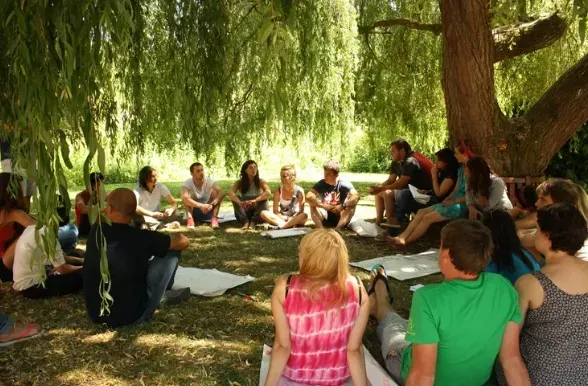
This surprises many first-timers: the community aspect of a retreat is often what people value most. Arriving among strangers and leaving with the sense of having had real conversations — the kind that don’t happen at dinner parties or in work meetings — is a common experience.
It doesn’t require you to share anything private or perform wellbeing for an audience. It simply happens when a group of people are in a slower, more open environment together. The conditions that help you rest also help you connect.
If you’re specifically seeking solitude, that’s available too — most retreat settings have enough space for both.
What to Pack (and What to Leave at Home)
Practically: comfortable clothing for being outside, layers for variable weather if you’re in the UK, walking shoes, a notebook if you tend to find that useful. Nothing specialist. Nothing requiring preparation.
What’s more interesting is what to leave behind — not your phone necessarily, but the posture that goes with it. The retreat environment works best when you’re not half-attending to it while managing everything else. Most people find that this shift happens naturally after the first day. The environment does more of that work than willpower does.
How to Know If You’re Ready
There is no perfect moment to go on retreat. Life will always have things pulling at it. The useful question is simpler: do you feel like something needs to change, even if you can’t name exactly what?
If the answer is yes, that’s enough. The retreat will meet you where you are.
If you’d like to understand what Asha Centre offers as a retreat setting, take a look at our spaces and programs.
